
Rosemary Essential Oil for Focus and Memory: What the Research Shows
Northumbria University researchers found that the more rosemary aroma people breathed in, the higher their blood levels of 1,8-cineole and the better they did on some mental tasks. What it shows, its limits, and how to use scent for focus.
"There's rosemary, that's for remembrance," says Ophelia in Hamlet. Four centuries later, rosemary is still the oil people reach for before an exam or a long day at the desk. There is some genuinely interesting research behind it, though it is narrower than most articles suggest. Here is what it shows, and how to use scent to support focus.
The rosemary research
Most of the evidence comes from a group at Northumbria University in the UK led by Mark Moss.
In a 2012 study published in Therapeutic Advances in Psychopharmacology, Moss and Lorraine Oliver placed 20 volunteers in a cubicle scented with rosemary essential oil for 4, 6, 8 or 10 minutes before they completed mental arithmetic and attention tasks. Blood samples showed that the longer people were exposed, the higher their blood levels of 1,8-cineole, rosemary's main aromatic compound. Higher cineole levels were associated with better performance on some tasks: more correct answers and faster responses on a serial subtraction test, and faster reaction times on others.
That finding is important because it suggests a physical route: compounds inhaled from the air reach the bloodstream in measurable amounts. The researchers proposed that cineole may act on acetylcholine, a brain chemical involved in memory and attention, though this was not tested directly.
The limits
The authors were clear about the caveats, and so should we be:
- Twenty people is a very small sample.
- The study was correlational. It showed that cineole levels and performance moved together, not that cineole caused the improvement.
- Not every task improved; accuracy on some tests showed no relationship.
- The effects were modest. Rosemary is not a study drug.
Earlier work by the same group, a 2003 study of 144 adults in the International Journal of Neuroscience, found that a rosemary-scented room was associated with better overall quality of memory and feeling more alert than a room with no scent, though memory responses were slightly slower. A lavender-scented room, by contrast, was associated with poorer working memory and slower reactions. Together these studies suggest that scent can nudge mental state in a direction, which matches most people's experience: rosemary for the desk, lavender for the evening.
Other oils used for focus
| Oil | Why people use it |
| Rosemary (cineole type) | The research above; clean, herbal, clarifying |
| Peppermint | Cooling and alerting; some studies link its aroma to alertness |
| Grapefruit and other citrus | Bright and uplifting; widely liked |
| Black pepper and cardamom | Warm, spicy lift without sweetness |
| Frankincense and vetiver | Grounding base notes that keep a blend from feeling scattered |
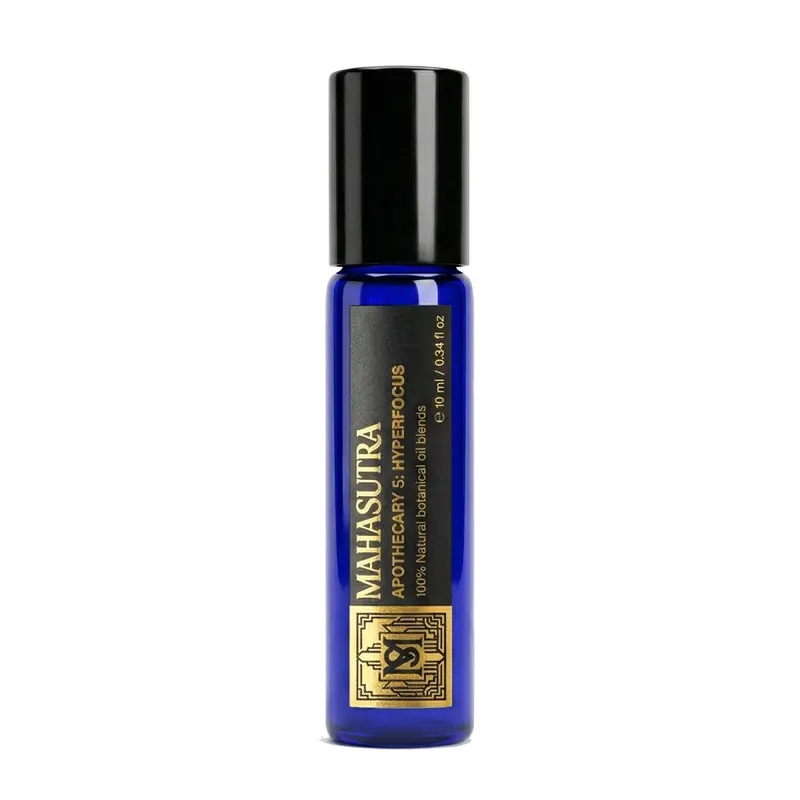
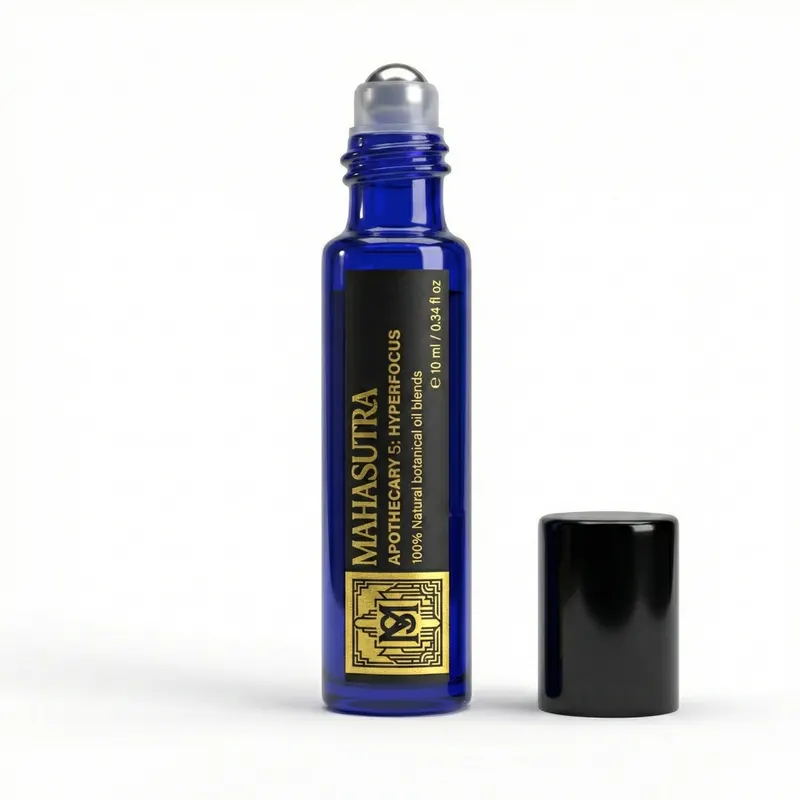
Our Hyperfocus Oil is built on this logic: rosemary cineole, peppermint, grapefruit and black pepper at the top, with frankincense and vetiver underneath for depth.
How to use scent to support focus
- Pair the scent with the task. Use the same aroma every time you sit down to work. Over time, the scent becomes a cue for focus, the same way coffee or a particular playlist can.
- Keep it light. A strong scent becomes a distraction. One or two drops on lava stones or a ceramic diffuser near your desk, or a roll-on at the wrists, is enough.
- Refresh during breaks. Our sense of smell adapts within minutes, so you stop noticing a scent. Reapplying at each break restores the cue.
- Combine with good habits. Short work blocks, breaks away from the screen, water and daylight do more for focus than any aroma. Use scent to support them.
Safety
Rosemary oil is generally well tolerated when diluted, but its cineole and camphor content means it should not be used on or near the face of babies and young children. People with epilepsy should avoid rosemary oil unless their doctor agrees, because camphor-containing oils have been linked to seizures. Avoid during pregnancy unless advised otherwise. Dilute before applying to skin; our dilution chart shows how. If headaches come with your long work days, read our guide to peppermint oil for headaches.
Common questions
Does rosemary oil improve memory?
Small studies at Northumbria University linked rosemary aroma and higher blood 1,8-cineole with better performance on some tasks. The effects were modest and the studies small.
What is the best essential oil for studying?
Rosemary has the most research; peppermint and citrus are also popular. Using the same scent each time you work can make it a cue for focus.
Is rosemary oil safe for everyone?
Avoid it on or near the face of young children, and people with epilepsy or who are pregnant should check with a doctor first.
This guide is for general information and is not medical advice. Speak to a doctor or pharmacist before using essential oils if you are pregnant, breastfeeding, take regular medication, have epilepsy, asthma or a skin condition, or are using them on a child.
Sources
- Moss M, Oliver L. Plasma 1,8-cineole correlates with cognitive performance following exposure to rosemary essential oil aroma. Therapeutic Advances in Psychopharmacology, 2012;2(3):103–113
- Moss M et al. Aromas of rosemary and lavender essential oils differentially affect cognition and mood in healthy adults. International Journal of Neuroscience, 2003;113(1):15–38